Kerala · Field guide · 9 min read
How to watch a Theyyam with respect
Where to stand, what to wear and when the camera goes down: a short guide for first-time visitors.
Before you plan · The numbers first
When to go: the season follows the dry months.
Most of Kannur's rain arrives between June and September. Theyyam gathers in the dry months after it, which is also when roads, shrines and sacred groves are easiest to reach.
2%
of Kannur's modelled yearly rain falls from December to March
About 49 of 2,410 mm
About 400
Theyyam forms are performed across North Malabar
Source: Kerala Tourism
The Theyyam season follows the dry months
Modelled average monthly rainfall in Kannur (mm), June to May
- In the season
- Season starts or ends
- Outside the season
View as table
| Month | Rainfall (mm) | Theyyam season |
|---|---|---|
| June | 615 | Outside |
| July | 555 | Outside |
| August | 362 | Outside |
| September | 210 | Outside |
| October | 230 | Starts or ends |
| November | 75 | In season |
| December | 19 | In season |
| January | 5 | In season |
| February | 4 | In season |
| March | 21 | In season |
| April | 83 | In season |
| May | 231 | Starts or ends |
A Theyyam is not a performance in the way most visitors expect, and the quickest way to understand it is to notice that nobody is performing for you. In the villages of North Malabar, a hereditary performer takes on the face, voice and authority of a deity, and the people gathered, many of them neighbours and many of them devotees, come with questions, grievances and blessings of their own.
Visitors are welcome at many shrines and sacred groves, but they are guests in someone else’s act of worship. What follows is a short guide to being a good one.
Arrive early, stand back
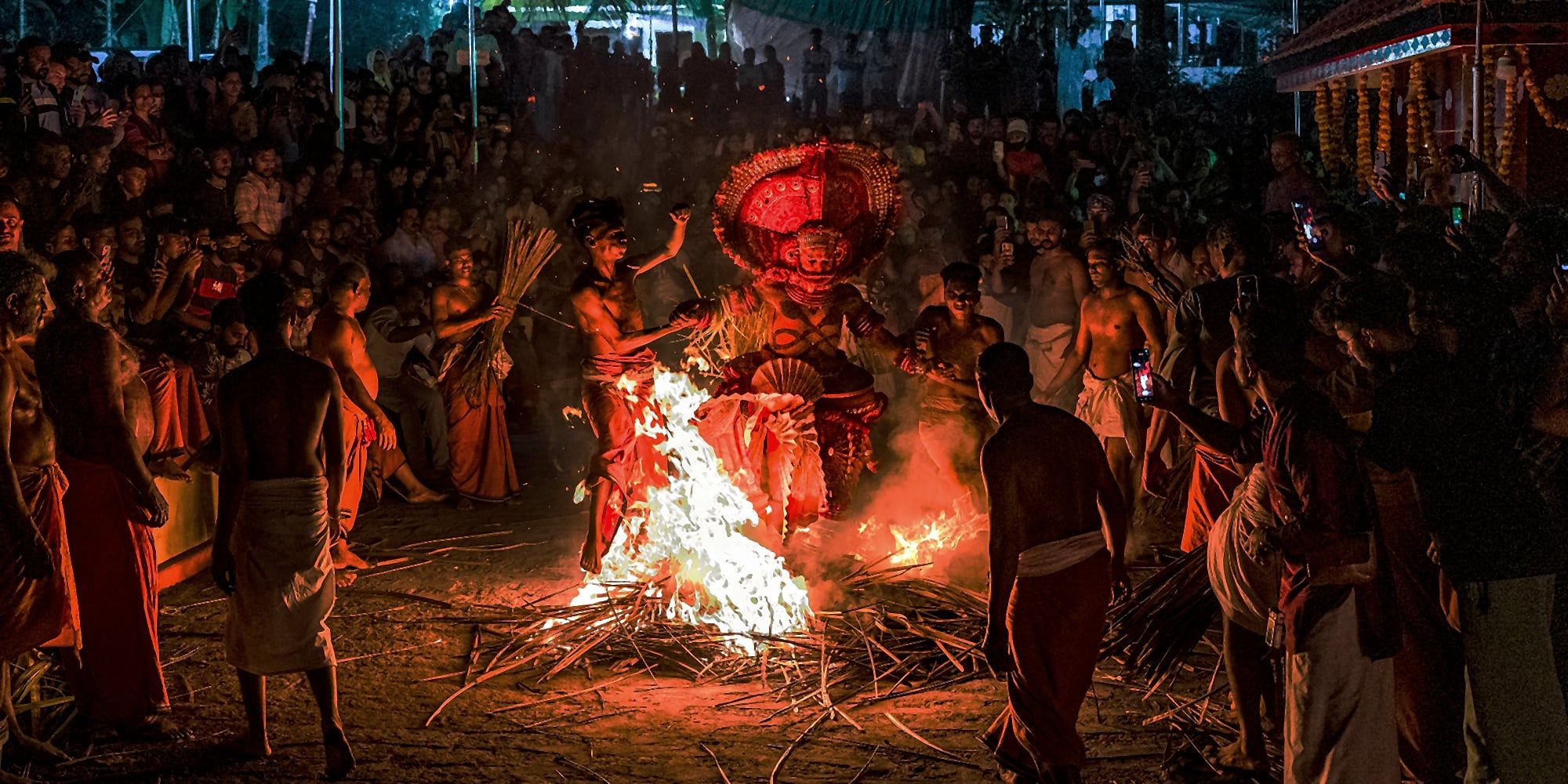
Some rituals run through the night and others begin before dawn. Arrive well before the main appearance, find a place at the edge of the gathering and keep the sightlines of those behind you clear. The front belongs to devotees.
A visitor’s place is at the edge.
Dress and cover
Dress modestly, with shoulders and knees covered. Footwear is usually left outside the shrine precinct; follow what the people around you do and ask quietly if you are unsure.
Put the phone down
If you photograph, ask first, and expect that at some moments the answer is no. Avoid flash entirely: it is intrusive, and unwise near open flame and elaborate costume. Never step into the performer’s space for a better angle.
Notice who is paid
Theyyam is carried by specific families, often from historically marginalised communities, as a hereditary duty. Where a visit involves money, whether a guide, a host or a donation, ask where it goes.
Know what you are watching
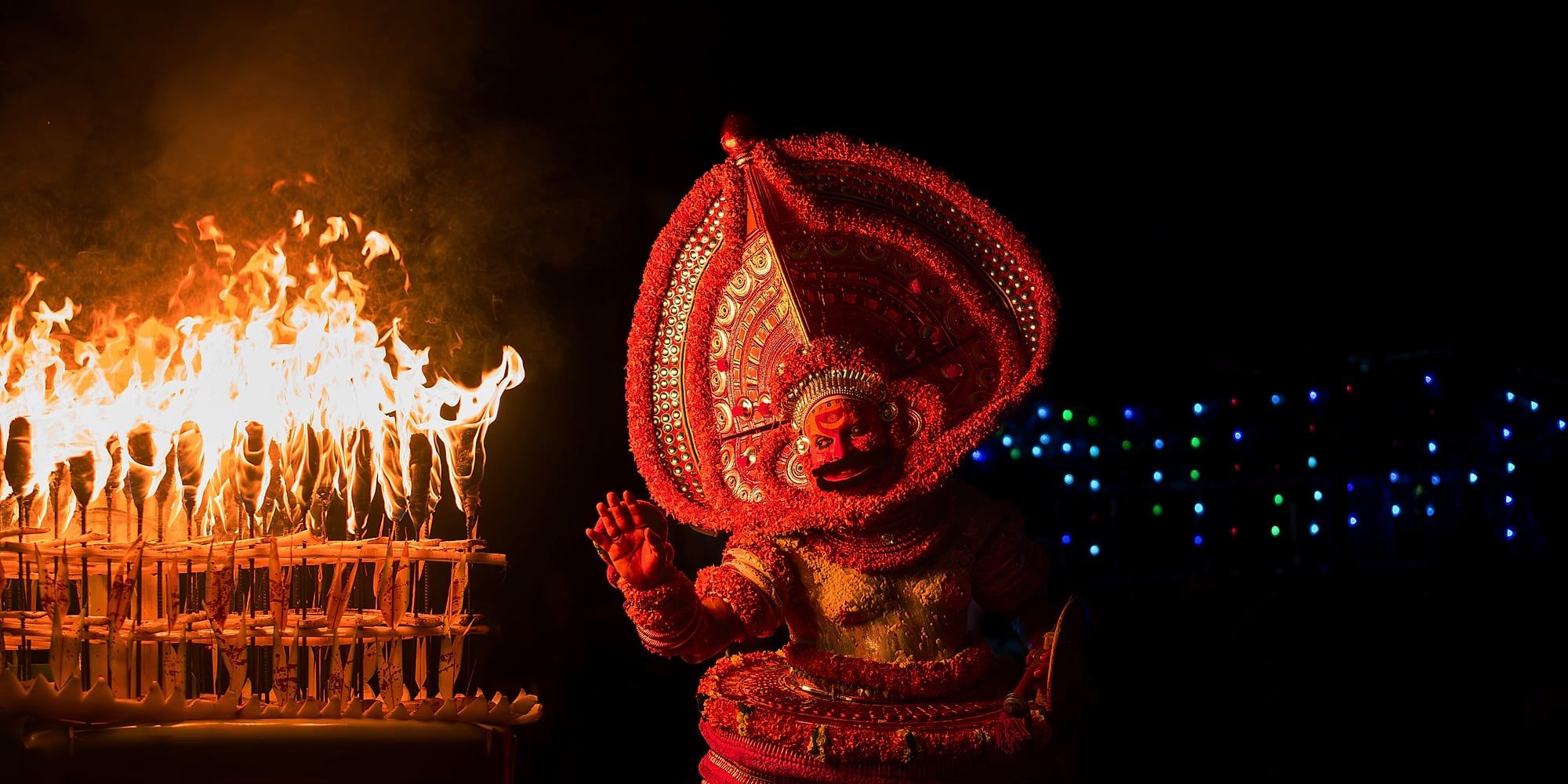
Theyyam is also called Kaliyattam, and its name is generally traced to the Malayalam word for god, daivam. Kerala Tourism says around 400 varieties are performed in North Kerala. Among the best known are Muchilottu Bhagavathi, Raktha Chamundi, Gulikan and Pottan, each with its own legend, costume and face painting.
Most performances run through the dark hours. At many shrines the first part is a preliminary invocation, sometimes called vellattam or thottam, in which the performer and the drummers recite the deity’s story in a lighter costume. The performer then returns to dress in full make-up and the tall headgear, the mudi, and the deity is understood to have arrived. The names and the order differ from shrine to shrine, so follow what the people around you do.
There is no stage and no curtain. The ritual happens in the open, in front of the shrine, with devotees close by.
Do not touch, do not step in
Do not touch the performer or the costume, and do not walk across the open space in front of the shrine. If a blessing is offered, receive it the way the people around you do. Keep away from the place where the performer is dressing unless you have been invited. Treat the performer and the musicians with the same courtesy as the deity: ask before you photograph them, and do not use them as a backdrop for pictures of yourself.
Not every shrine is the same
Reverence for the deity does not always extend to the person inside the costume. In October 2023 The News Minute reported that Theyyam is performed by men from seven Scheduled Caste and Scheduled Tribe communities, and that performers from some of them, including the Nalkadaya and Mavilan, said they are kept outside shrine precincts or given poor facilities at certain temples in Kasaragod. Some temple committee members told the publication that these are old ritual customs, not caste discrimination.
We mention this because it changes what a thoughtful visitor does. Ask your host which shrine you are going to and who looks after it. Ask where any money goes. Be courteous to everyone who carries the night, not only to the figure at its centre.
Plan for a long night
Many Theyyams run from late evening into the early hours, and some begin before dawn. Eat before you go, bring water and a torch, and keep the next morning free. Do not plan a long drive straight after.
Finding a performance
There is no central ticket office. Kerala Tourism publishes a Theyyam calendar at keralatourism.org/theyyamcalendar/, but shrine calendars change, so confirm with a local host, a homestay or the kavu committee before you set out, and ask whether visitors are welcome that night.
If your dates fall outside the season, there is one Theyyam performed every day. We have written about it in Theyyam every day: the Muthappan temple at Parassinikkadavu.
More on Theyyam
- What Theyyam is: the ritual, the season and how it is tied to the shrines.
- Theyyam every day at Parassinikkadavu: the Muthappan temple, its timings and what to confirm locally.
- Theyyam night in Kannur, the film: the rhythm of a night at the kavu, and filming etiquette.
- Theyyam visitor etiquette card: the rules on one page.
- Kerala and Theyyam: the season calendar, the data and every Kerala story.
Before you decide
Go as a guest. Attend only where visitors are welcome, stand where you are asked to stand, and let devotees have the front.
Skip it if: you want a staged performance, a fixed schedule or a photograph-first experience.
- Ask your host which shrine, which night and whether visitors are welcome.
- Dress modestly, put the phone down and use no flash.
- Ask where any money goes.
Planning tools for this trip
- Theyyam visitor etiquette card: Where to stand, what to wear and when to put the camera down.
Questions readers ask
Can anyone go to a Theyyam?
Many shrines and sacred groves welcome visitors, but each shrine and its committee sets its own rules, and some restrict who may enter or stand where. Ask your host which shrine has a Theyyam on which night, and whether visitors are welcome that day.
Can I take photographs?
Ask first and accept a no. Do not use flash, and never step into the performer's space for a better angle.
How many kinds of Theyyam are there?
Kerala Tourism says around 400 varieties are performed in North Kerala. Each is tied to particular shrines, families and legends.
What is the difference between a Theyyam and a stage dance performance?
A Theyyam is an act of worship. The performer is understood to take on the deity, and devotees come to seek blessings, so there is no stage, no ticket and no audience in the usual sense.
Sources
Corrections
No corrections so far. If something is wrong, tell us below and we will fix it here with a dated note.
Help us get it right