Yoga · Mysuru · 8 min read
Ashtanga Yoga in Mysuru: How Mysore-Style Practice Works
What Mysore-style Ashtanga actually is, how the Mysuru institute grew, and what to check before planning a month of practice there.
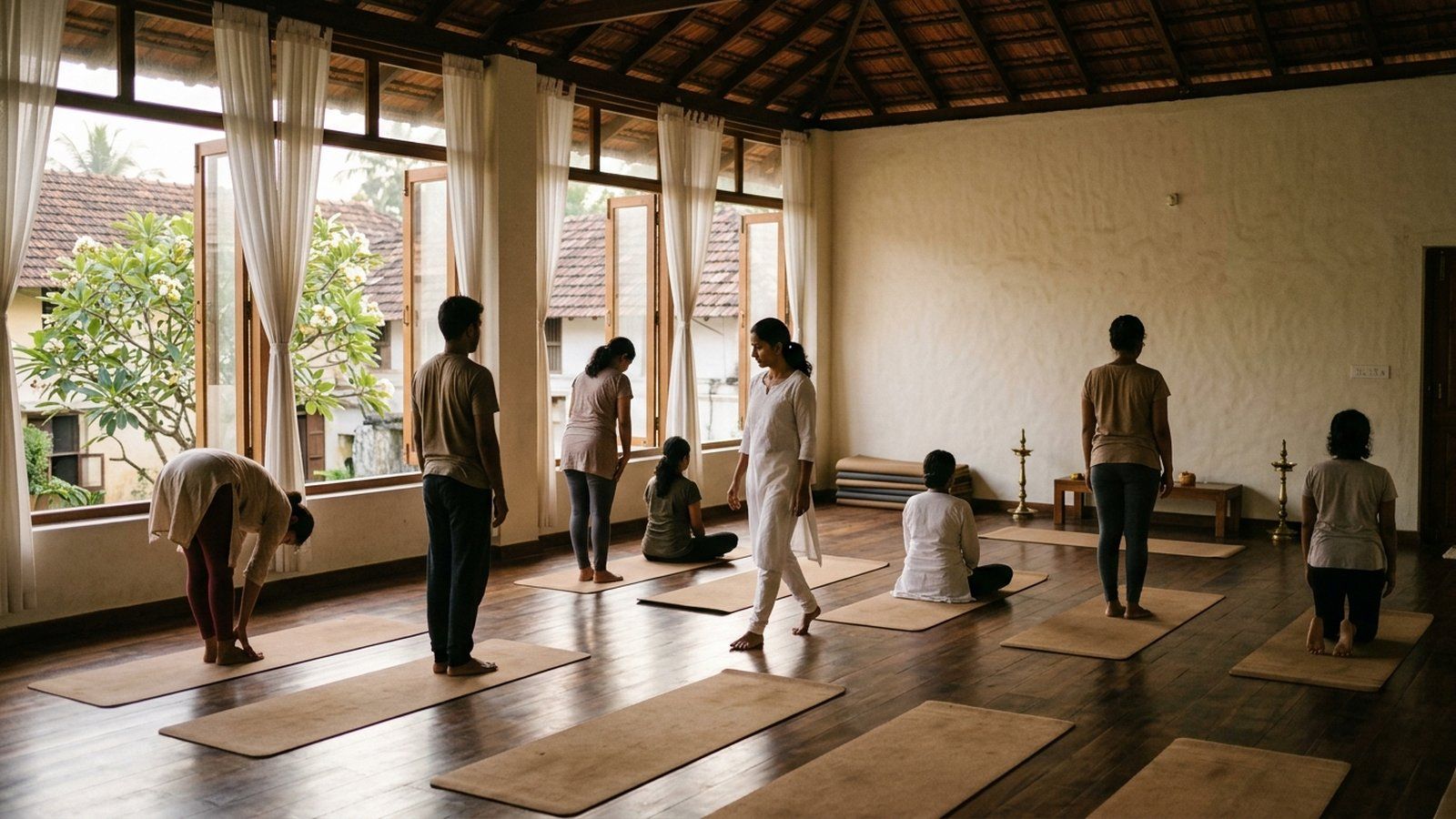
Ashtanga yoga is a fixed sequence of postures linked by breath, and Mysore-style is the traditional way of learning it: each student practises at their own pace in a shared room while a teacher gives individual help. Mysuru, where the method was taught by K. Pattabhi Jois, remains the pilgrimage place for serious students, but registration rules change, so confirm them with the institute before you plan a trip.
Mysuru is a calm palace city in southern Karnataka, and it is also one of the best-known addresses in modern yoga. People travel there from all over the world to practise Ashtanga at the place where the method was taught for most of the twentieth century.
What is Ashtanga yoga?
Ashtanga means “eight limbs” and refers to the eight-part path described in Patanjali’s Yoga Sutras. The modern Ashtanga vinyasa method that took that name was taught by K. Pattabhi Jois, who lived from 1915 to 2009. He founded the Ashtanga Yoga Research Institute in Mysore in 1948. After his death the school became the K. Pattabhi Jois Ashtanga Yoga Institute. It moved to a purpose-built shala (a yoga school or hall) in the Gokulam area in 2002.
The method uses a fixed sequence of postures, called series. Most students spend a long time on the first, the primary series, before moving on. Each posture is linked to the next with a vinyasa, a movement tied to breath, and with a set gaze point called drishti.
What does “Mysore-style” mean?
It is the traditional teaching format, and it differs from a typical studio class.
- There is no led class. Students arrive, usually early in the morning, and begin the sequence they have been given.
- Everyone is at a different point. One student may be on the opening postures while the person on the next mat is in the middle of the series.
- The teacher walks the room. They offer adjustments and add the next posture when they judge you ready.
- The sequence is memorised. Over time you learn it by heart and practise without instruction.
The usual pattern is six days of practice a week, with rest on Saturdays and on full and new moon days. The approach suits people who like routine and are willing to repeat the same sequence for months.
How did Mysuru become the centre of Ashtanga?
Pattabhi Jois taught in the city for decades, and students who came to study with him in the 1970s and later carried the method abroad. Many Mysore-style teachers around the world trace their training to him. His grandson, R. Sharath Jois, led the institute after Pattabhi Jois’s death. He died in November 2024, so the institute’s current leadership and arrangements should be confirmed on its own website and not taken from older guides.
What should you check before planning a trip?
Rules for registration, fees, minimum stay and prerequisites have changed over the years. Older guides describe advance online registration, a commitment to practise with one teacher while you are enrolled and a requirement to have trained with an authorised teacher beforehand. Treat all of that as background, not current policy.
Before you plan:
- Read the institute’s current registration page and follow its process exactly.
- Ask about prerequisites and whether previous study with an authorised teacher is required.
- Budget for a month or more. The method rewards continuity and shorter visits are often a poor fit.
- Check other shalas. Several teachers in Mysuru offer Mysore-style classes. Ask who trained them.
- Look into accommodation early, because the Gokulam area fills quickly in the busy periods.
What is daily life like for a student?
Students typically practise in the early morning, often before dawn, then have breakfast and rest. The rest of the day tends to be quiet: rest, a meal, some reading and an early night. Many students find the routine, rather than any single posture, is the hardest part. Expect to be sore for the first week or two.
Is it right for you?
Ashtanga suits people who like structure, enjoy physical effort and are happy to be corrected. It is less suitable if you want variety, gentle pacing or a more philosophical approach. If you are not sure, try other styles first. Our guide to yoga styles compares them, and how to choose a yoga retreat covers the practical questions.
Questions readers ask
What does Mysore-style mean?
In a Mysore-style class students practise the same traditional sequence at their own pace, in the same room, while a teacher moves around giving individual help. It is named after the city where the method was taught.
Do I need to go to Mysuru to practise Ashtanga?
No. Mysore-style classes are taught in many countries. Going to Mysuru is for people who want to practise at the source of the lineage, and it is usually a commitment of a month or more.
Who founded the Mysuru institute?
K. Pattabhi Jois (1915 to 2009) founded the Ashtanga Yoga Research Institute in Mysore in 1948. It was later renamed the K. Pattabhi Jois Ashtanga Yoga Institute and moved to a new shala in the Gokulam area in 2002.
Is it only for advanced students?
The institute and other shalas set their own conditions. Older guides cite prerequisites such as prior study with an authorised teacher, so check the current rules and ask what level a shala expects.
Sources
Corrections
No corrections so far. If something is wrong, tell us below and we will fix it here with a dated note.
Help us get it right